

Passive Fire Compliance Checks: What Building Managers Should Look For
May 11, 2026
Passive fire protection is one of the most important parts of building safety, yet it is often overlooked because many of its systems are hidden within walls, ceilings, doors, service risers and plant areas. These systems are expected to perform during an emergency, but they can be compromised over time by maintenance work, tenant fit-outs, service upgrades and undocumented alterations. Through the guidance of a qualified passive fire consultant, building managers can better understand how compartmentation, fire stopping and fire-resisting systems should perform, and where common compliance failures are likely to occur.
IECC outlines the key passive fire elements that require regular compliance checks, including fire doors, rated walls and ceilings, service penetrations, dampers, collars and compliance records. The article also explains the warning signs of compromised fire resistance, practical inspection priorities and the importance of accurate documentation in supporting building safety, insurance requirements and ongoing regulatory compliance.
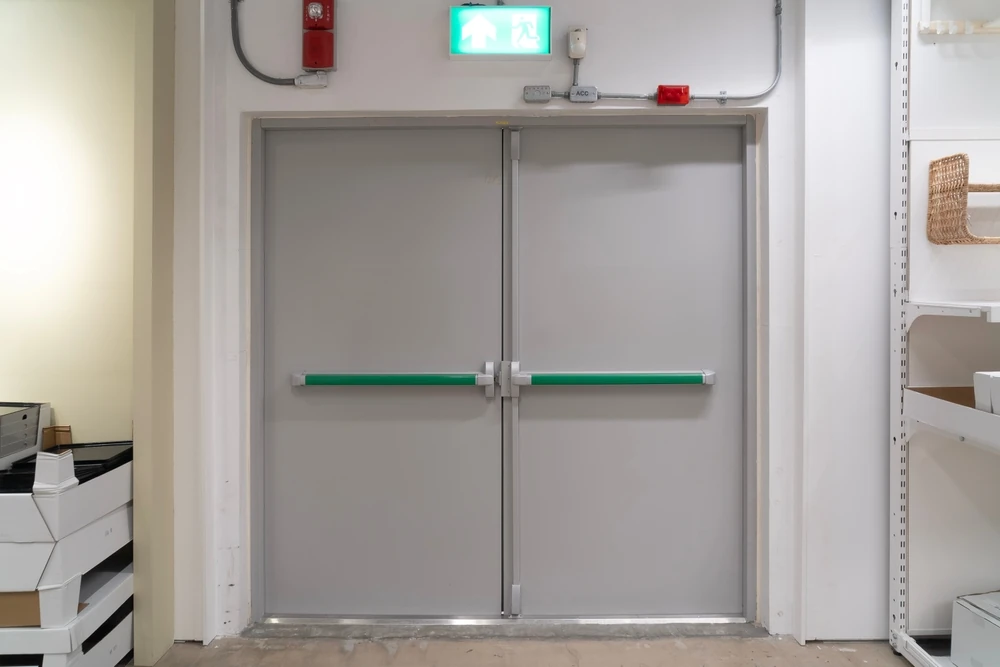
Passive fire protection is only effective if it remains intact and performs as designed during a fire. Regular compliance checks help confirm that fire-resisting walls, floors, doors and service penetrations still provide the required compartmentation and fire-resistance periods. Without these checks, small defects or unapproved alterations can quietly reduce a building’s built-in fire safety.
Building managers also carry important legal and safety responsibilities. Compliance checks create documented evidence that fire protection measures are being maintained, defects are being identified and risks are being managed. This can support smoother interactions with regulators, insurers, auditors and other stakeholders.
The primary purpose of passive fire protection is to slow the spread of flame, heat and toxic smoke long enough for occupants to escape and emergency services to respond. Over time, routine maintenance, tenant fit-outs and informal repairs can undermine that protection if penetrations, doors or barriers are not reinstated correctly.
Compliance checks should confirm that compartment walls and floors remain continuous, service penetrations are correctly fire stopped, fire doors close and latch properly, smoke seals and intumescent strips are intact and escape routes remain protected to the required fire-resistance rating.
If these elements are compromised, smoke and fire can bypass compartments and reach escape routes more quickly. This reduces available evacuation time and increases life-safety risk, particularly in complex buildings such as hospitals, hotels, high-rise offices, residential blocks and aged care facilities.
Fire safety legislation in most jurisdictions requires fire protection measures to be maintained in efficient working order and good repair. Authorities and insurers generally expect not only compliant design and installation, but also evidence of ongoing inspection, maintenance and rectification.
Routine passive fire compliance checks help demonstrate that building management has taken reasonable steps to maintain safety. They also allow non-compliances to be identified before they become larger issues during formal inspections, insurance reviews, due diligence processes or fire investigations.
If a fire occurs, investigators will often examine whether passive fire systems were properly maintained and whether known defects were ignored. Clear inspection records, defect registers and rectification evidence can help reduce exposure to enforcement action, prosecution, insurance disputes and liability claims.
Damaged or poorly altered fire compartments often remain hidden behind ceilings, riser doors, service cupboards and wall linings until a refurbishment or major inspection reveals the problem. By that stage, remediation can be extensive, disruptive and expensive.
Regular compliance checks help control long-term costs by identifying localised issues early, such as unsealed penetrations, damaged fire doors or missing labels. These problems are usually simpler and less expensive to fix when they are found promptly. Checks also help prevent defects from spreading across multiple areas of a building as more contractors access services over time.
A building with clear passive fire records and verifiable fire-resisting systems is generally easier to manage, insure, lease, sell or refurbish. In contrast, unverified or visibly compromised fire compartments can delay transactions, increase perceived risk and reduce confidence in the building’s overall condition.
Fire doors, frames and associated hardware are critical parts of passive fire protection. If they fail, fire and smoke can spread through escape routes, corridors, stairwells and compartment lines. Routine compliance checks should confirm that each fire door assembly can resist smoke and flames for its rated period and will reliably close and latch under fire conditions.
Inspections should focus on three core areas: identification and rating, physical condition and operation. A consistent inspection method helps defects to be recorded clearly and rectified without delay.
Each fire door assembly must be suitable for its location and the fire compartment it protects. Labels or markings are usually found on the top or vertical edge of the door leaf or on the frame. These labels help verify the door’s rating and suitability.
If a label is painted over, damaged or missing, the door can no longer be reliably verified without further assessment. In that situation, it should be reviewed by a competent fire door specialist. Vision panels should also be checked to confirm that they contain fire-rated glass, intact glazing beads and suitable intumescent liners that match the door’s required rating.
Physical damage is one of the most common causes of fire door non-compliance. The door leaf should not be warped, split, holed or modified with unapproved openings for cables, devices or accessories. Any penetration through the door leaf or frame must be sealed with tested fire-stopping components suitable for that exact application.
Door gaps should also be checked carefully. The clearance between the leaf and frame at the sides and head is commonly expected to sit within a narrow tolerance, and threshold gaps must comply with the relevant requirements for the building, particularly where smoke control is required. A gap gauge should be used rather than relying on visual estimates.
Frames must be firmly fixed to the surrounding wall with no movement when the door is operated. Cracks or gaps between the frame and wall should be sealed with an approved fire-rated sealant or intumescent material, not general-purpose foam or filler.
A fire door that does not close and latch fully will not perform as intended. Self-closing devices should be checked to confirm that the door closes from any open position and latches securely without slamming. The closing action should allow safe passage for occupants while still ensuring full closure.
Locks, latches, panic bars and hinges must be fire-rated and correctly fixed using the required screws in all fixing positions. Missing or loose fixings can undermine the performance of the whole assembly. Additional hardware, such as kick plates, access control devices or door viewers, must not interfere with closing or compromise the door’s tested configuration.
Intumescent strips and smoke seals around the door perimeter should be continuous, undamaged and firmly attached. Sections that are painted over, cut, missing or perished should be replaced with products that match the door’s rating and profile. Unapproved hold-open devices, such as wedges or hooks, should be removed. Where hold-open functionality is needed, it should be provided through compliant electromagnetic devices linked to the fire alarm system.
Fire-rated walls, ceilings and barriers form the backbone of a passive fire strategy. They compartmentalise a building so that fire, heat and smoke are contained long enough for occupants to escape and firefighters to intervene. For building managers, the main task is to verify that these elements are present where required, correctly rated and free from damage or unapproved alterations.
Many compliance failures do not come from the original construction. They occur later, when fit-outs, service upgrades, maintenance work or access requirements compromise the tested fire performance of the building. Regular visual inspections, supported by accurate records of fire-resistance ratings, are essential.
The starting point is to understand the fire-resistance ratings specified in the fire strategy, fire engineering report and construction documents. Critical locations often include escape corridors, stair enclosures, plant rooms, riser shafts, service cupboards and separations between different occupancies or uses.
Managers should check that fire-rated walls and ceilings are labelled where required, fire-stopping systems have identification tags where applicable, and penetrations or openings correspond with approved drawings, schedules or registers. Any penetration through a rated barrier should achieve a fire rating equal to or higher than the barrier itself.
Where labels are missing, illegible or inconsistent with the documentation, the rating should not be assumed. Professional verification may be needed before the element can be accepted as compliant.
Physical damage and unplanned openings are common causes of non-compliance. Walls and ceilings designed to resist fire for 30, 60, 90 or 120 minutes can fail early if they are cracked, cut, weakened or left with unprotected gaps.
Inspections should look for holes or notches cut for cables, ductwork or pipework, gaps at junctions between walls, floors and ceilings, impact damage from maintenance activity, and missing tiles or access panels in rated suspended ceilings.
Particular attention should be given to service risers, ceiling voids, plant rooms and back-of-house areas where uncoordinated works are common. Any opening that is not part of a tested assembly, or that has not been properly fire stopped to the required rating, represents a compartment breach and should be rectified.
For a fire-rated barrier to perform, it must remain continuous from one fire-separating element to the next. The materials, junctions and seals all need to match the intended fire-resisting system.
Checks should confirm that plasterboard, masonry or concrete thicknesses match the specified rating, board joints are correctly taped and finished, and fire-rated ceilings are not bypassed by unprotected voids or walls that stop short of the slab or roof above.
Junctions between different materials, such as plasterboard to concrete or steel, should be sealed with tested fire-stopping products rather than generic sealants or foam. Where structural elements such as beams or columns pass through walls or ceilings, the surrounding sealing must be compatible with both the structure and the rated barrier.
Service penetrations are among the most common weak points in a fire compartment. Every pipe, cable tray, duct or conduit that passes through a fire-resistant wall, floor or ceiling creates a possible path for fire and smoke if it is not correctly sealed.
Routine checks should focus on whether each penetration is protected by a tested fire-stopping system that is intact, appropriate for the service type and consistent with the original design. Compliance is not achieved by simply filling a visible gap. Fire stopping must match a tested configuration, including the substrate type, service material, opening size, installation method and required fire rating.
Any deviation, unrecorded change or ad hoc repair can compromise compartmentation and make the original certification unreliable.
The presence of material around a service does not prove compliance. The product must be suitable for the construction, the type of service passing through it and the required fire rating. It must also be installed in accordance with the tested system.
Common warning signs include painted-over domestic filler, expanding foam of unknown type, loose mineral wool with no coating, cracked sealant, missing backing material or seals that do not fully close the opening around the service.
Identification labels or tags at each penetration are strongly advisable. They link the seal to a specific tested system, installer, rating and register entry, making future inspections and maintenance much easier.
Most passive fire failures occur after refurbishment or service upgrades, when new penetrations are created or existing ones are disturbed. Building managers should require any contractor creating or modifying service openings to use suitable certified fire-stopping products and provide proper installation records.
Compliance checks should confirm that newly installed services have been re-sealed with compatible systems, penetration schedules have been updated, drawings have been marked up and photographic records have been kept where possible.
Where there is doubt, an independent inspection by a competent fire-stopping specialist is recommended. Non-compliant or undocumented penetrations should then be prioritised for remedial works based on the level of risk they present.
Fire and smoke can spread quickly through building services if passive components are missing, damaged or incorrectly installed. Fire dampers, collars and other concealed systems inside ceilings, risers and shafts are often overlooked during routine checks, yet they are critical to maintaining compartmentation.
Property managers should approach these systems methodically. The priority is to confirm that every relevant duct, pipe or service passing through a fire-resisting barrier has the appropriate tested protection in place, remains accessible for inspection and has not been compromised by later works.
Fire dampers are fitted where ducts pass through fire-resisting walls, floors and shafts. They are designed to close during a fire so that flames and hot gases cannot bypass the compartment line.
Compliance checks should confirm that dampers are installed where required by the fire strategy, accessible through clearly identified access panels and positioned correctly within the wall or floor. For fusible link dampers, links should be intact, clean and free from paint or contamination. The damper should sit square within the opening, with no distortion to the blades.
The fire stopping around the damper sleeve is just as important as the damper itself. Gaps between the sleeve and surrounding structure must be sealed using a tested fire-stopping system suitable for the damper type and fire rating. Any damper that is painted shut, blocked by fixings or propped open should be treated as an urgent life-safety defect.
Where plastic pipes or certain insulated metal pipes pass through fire-rated elements, intumescent pipe collars or wraps are often required. Under heat, these products expand to seal the void left when plastic softens or melts.
Checks should confirm that collars and wraps are present where required, correctly rated, firmly fixed and free from damage. They should not be loose, missing fixings, covered by later finishes or disturbed by new services.
Similar principles apply to cable bundles and combustible pipe insulation, where intumescent wraps, pillows, mortars or other tested systems may be specified. As with other passive fire elements, the system used must match the service type, opening size, substrate and required fire rating.
Passive fire protection is only as reliable as the evidence that proves it was designed, installed and maintained correctly. For building managers, documentation and labelling provide the link between what is visible on site and what was approved in the fire strategy or construction documentation.
This paperwork is also what regulators, insurers, auditors and future contractors expect to see. Without current and complete records, the building’s passive fire strategy becomes difficult to verify, even if some elements appear to be in place.
Regularly checking that documentation is accurate, labels are intact and compliance records are up to date is just as important as the physical inspection of fire doors, penetrations and barriers.
At the core of any compliance file are the documents that define what was intended, approved and installed. As a minimum, building managers should be able to locate the fire strategy report or fire engineering report, approved architectural and fire compartmentation drawings, fire door schedules, penetration registers, product data sheets and certification for key fire-resisting systems.
Product documentation should include third-party certification, test reports or assessments where relevant. It should also confirm that the systems installed on site match the tested configurations in the documentation. This is particularly important for fire stopping, structural protection, fire-rated glazing, fire doors and protected escape route linings.
Labels provide traceability between the physical installation and the compliance file. Managers should verify that critical passive fire elements carry permanent, legible labels or tags where required or where they form part of the compliance system.
Labels should align with the fire-stopping register, fire door schedule and relevant certification records so an inspector can move from the physical item to the matching documentation without confusion. Missing or illegible labels should be treated as a compliance issue and replaced only after confirming that the underlying construction matches the documented system.
A detailed passive fire inspection is not just a paperwork exercise. It is the point at which hidden weaknesses in fire compartments, fire stopping, fire doors and concealed systems are systematically identified before they are tested by an actual incident.
The most effective building managers treat these inspections as part of the asset’s lifecycle planning. Rather than waiting for a problem, they schedule inspections at predictable trigger points and bring them forward when building works or risk changes make a review necessary.
Several events should prompt a detailed review of passive fire protection. A full inspection is strongly recommended at practical completion or handover of a new build, so compartmentation, fire stopping, fire doors and structural fire protection can be checked against the design and certification.
An inspection should also be arranged after major refurbishment, fit-out work or layout changes, especially where walls have been moved, ceilings opened or services re-routed through fire-resisting elements. Major tenancy changes may also justify a review where the use type, occupancy density or fire load increases, such as converting office areas into data centres, laboratories or high-storage areas.
At each of these points, the as-built or as-modified condition can drift away from the original drawings. An intrusive inspection that checks above ceilings, within risers and behind accessible finishes may be needed to confirm that fire separation still performs as required.
Certain warning signs should trigger an early inspection regardless of the usual schedule. These include repeated fire door defects, damaged frames, broken closers, non-compliant glazing, visible unsealed penetrations and evidence of contractors frequently accessing concealed spaces without proper reinstatement controls.
Reports from fire drills can also reveal potential compartmentation problems, particularly if smoke movement, congestion or escape route performance raises concerns. Any fire incident, even a minor one, should prompt a review of affected passive fire systems to confirm that heat, smoke, water damage or temporary repairs have not compromised separation.
Regulatory changes, updated guidance, changes in building classification or insurer requests may also require a formal review. In these situations, a detailed inspection helps confirm whether existing passive fire measures still achieve the required level of performance.
Inspection frequency should be proportionate to risk. High-rise residential buildings, hospitals, care facilities, large assembly venues and entertainment facilities usually require more frequent detailed inspections than low-risk, low-rise, single-tenant commercial buildings.
Many duty holders adopt a cycle where high-risk buildings receive a full intrusive inspection every three to five years, supported by lighter annual condition checks of doors, service penetrations and structural fire protection. Medium-risk commercial buildings may suit a five-year intrusive inspection cycle aligned with planned maintenance. However, any building that undergoes alteration between scheduled inspections should be reviewed sooner rather than waiting for the next planned date.
Effective passive fire compliance depends on far more than initial installation. Fire-resisting systems must remain intact, documented and maintained throughout the life of the building. Even small defects, missing records or undocumented modifications can undermine compartmentation and increase life-safety, compliance and insurance risks.
By treating passive fire protection as a critical operational responsibility, building managers can better protect occupants, preserve asset value and satisfy strict regulatory and insurance expectations. Regular checks, accurate records and timely specialist inspections all help ensure that passive fire systems are ready to perform when they are needed most.