

Beyond Compliance: Performance-Based Passive Fire Protection in Complex Design
March 4, 2026
As building envelopes become more intricate and sustainability targets more ambitious, traditional prescriptive fire protection strategies are reaching their limits. IECC, a passive fire specialist, increasingly encounters projects where complex geometry, advanced façades and innovative materials challenge the assumptions embedded in conventional codes. In this evolving context, performance-based passive fire protection is no longer a niche approach. It is a practical tool for aligning fire safety with architectural freedom, energy efficiency and long-term resilience.
This article explains how performance-based thinking reshapes passive fire protection in complex design. You will see how performance criteria can be defined and quantified, how advanced modelling and risk assessment inform material selection and detailing, and how early interdisciplinary coordination prevents conflicts between fire safety, sustainability and constructability. By understanding these dynamics, stakeholders can move beyond a minimum-standard mindset towards fire strategies that satisfy regulatory expectations and actively enhance building performance.
Performance-based passive fire design shifts the focus from simply following Deemed-to-Satisfy tables to demonstrating that a proposed system meets the relevant NCC Performance Requirements for fire and smoke control. Rather than relying on overseas listing systems or generic “hourly ratings” taken out of context, the team substantiates the solution using suitable evidence and NCC assessment methods. This commonly includes tested systems, assessments, and documented engineering analysis that show the assembly will maintain structural adequacy where required, limit fire and smoke spread, and support safe egress for the design scenario and required timeframes.
For complex buildings, unusual geometries, or non-standard materials, a Performance Solution allows passive fire protection to be tailored to the actual hazards and building configuration while still achieving an equivalent or higher level of safety. The key is transparency: objectives, assumptions, limitations, installation requirements, and verification steps are clearly recorded so certifiers and reviewers can follow how compliance is achieved and what must be maintained on site and through the building’s life.
A performance-based passive fire rating begins with clearly defined objectives and criteria. Typical targets include maintaining the following:
Instead of only citing a “2-hour wall” from a catalogue, professionals identify what that 2-hour rating must accomplish in the context of the building. For example, a performance objective might be to keep escape corridors tenable for 90 minutes given a fuel load from high-density storage or to protect a transfer girder supporting multiple floors.
Specialists typically combine several technical tools to substantiate performance:
Documentation is critical. The performance basis, models, assumptions, safety factors and validation against recognised standards must be recorded in a format that the building certifier/building surveyor and any peer reviewer (and, where required, relevant agencies) can follow.
For a performance-based passive fire approach to be accepted, it must demonstrate compliance with the relevant NCC Performance Requirements using appropriate NCC assessment methods and supporting evidence. In practice, the building certifier/building surveyor (and, where required, peer reviewers and relevant agencies) will look for a clear, traceable case that the solution delivers an equivalent or higher level of safety than a Deemed-to-Satisfy pathway.
They typically expect the submission to:
When documented in a structured, auditable way, this approach reduces approvals risk and gives stakeholders confidence that the passive fire measures are technically sound, buildable on site, and capable of being verified at installation and maintained over the building’s life.
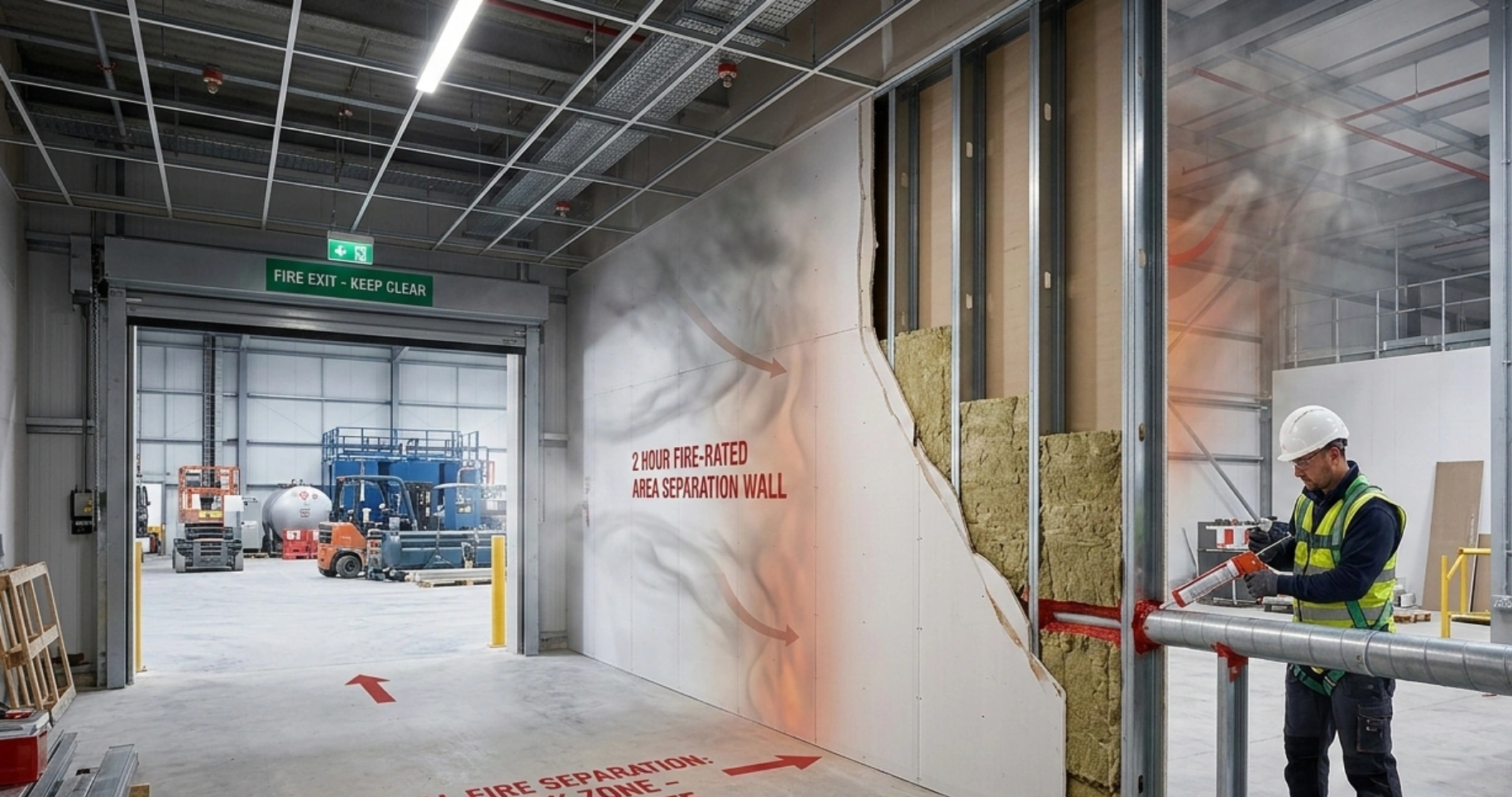
In bushfire-prone areas, fire risk is often driven by external attack (embers, radiant heat and flame contact) as much as it is by internal fire scenarios. In Australia, this external hazard is primarily addressed through AS 3959 (BAL construction requirements) and the NCC’s bushfire-related provisions. Passive fire protection and internal compartmentation still matter, but they sit alongside bushfire-resilient envelope design rather than replacing it.
For complex sites, critical infrastructure, or buildings with unusual façades and junctions, a performance-based approach can help teams document how the envelope resists bushfire exposure and how internal fire and smoke separations remain continuous and maintainable if the building is breached.
For bushfire exposure, the first priority is an envelope that resists ember entry and limits ignition pathways. The practical focus is on tested or compliant BAL construction details, especially at the weak points where embers and heat exploit gaps.
Key design measures typically include:
Where the geometry is complex (façade steps, deep recesses, articulated roof forms, mixed materials), performance-based documentation can be used to explain how ember pathways are interrupted and how junctions are detailed so the envelope performs as intended under bushfire exposure.
If embers or flame breach the envelope and ignition occurs internally, the building’s internal fire safety strategy becomes critical. This is where NCC fire and smoke separation principles apply, including continuous fire-resisting construction where required, protected paths of travel, and properly sealed penetrations.
Performance-based design often focuses on:
The key for complex buildings is to treat internal separation as a coordinated system, not a set of isolated details. That means documenting interfaces, allowable variations, and inspection requirements so the as-built outcome matches the design intent.
For infrastructure, industrial sites and the wildland–urban interface, the risk profile often involves both external bushfire exposure and high internal fuel loads. Passive measures need to be planned so the loss of one area does not trigger avoidable escalation across the asset.
A robust, Australia-aligned approach typically includes:
Where performance-based methods are used, the documentation should make it obvious which requirements relate to bushfire exposure (AS 3959/BAL) and which relate to internal fire safety (NCC fire/smoke separation and passive protection), so responsibilities at design, construction and maintenance are clear.
In dense mixed-use campuses, tall buildings and irregular structures, passive measures often need to be coordinated with active systems to achieve the level of resilience owners expect and to satisfy project performance objectives. Specialists view active and passive measures as a single fire safety ecosystem, where detection, suppression and compartmentation are designed together and verified through performance-based analysis rather than checked in isolation against prescriptive tables.
This integration becomes especially important when architectural ambition challenges straightforward compartment layouts, or when building use changes over time. Coordinated strategies can help maintain evacuation routes, protect structural integrity and support firefighting operations, even if one layer underperforms or is temporarily compromised.
Performance‑based design allows trade‑offs that still meet or exceed code objectives. Instead of simply adding thicker walls or more sprinklers, professionals test multiple combinations until fire growth, structural stability and evacuation criteria are all satisfied.
Typical applications are the following:
The key is to set explicit performance targets, such as maximum temperature at critical structural members or allowable visibility in escape routes then prove with simulation and calculations that the combined active and passive package meets those targets.
Integrated solutions only perform as designed if interfaces are simple and maintainable. Reduce long‑term failure risk, such as coordinated pathways for MEP services that minimise penetrations of rated assemblies and standardised firestopping systems across the project.
Fire alarm cause‑and‑effect matrices should clearly link detection to suppression, smoke control and door release aligned with the passive strategy. For example, opening specific smoke dampers while holding certain doors closed to preserve the intended compartment pattern.
Performance‑based reports and as‑built fire strategy drawings must be kept current so that later fit‑outs or tenant changes do not undermine the original balance between active and passive protection. Regular joint inspections of both system types help verify that modelling assumptions remain valid through the building's life.
Sydney’s high‑density projects face short submission windows, frequent inspections and third‑party reviews. To keep complex performance‑based passive fire strategies moving through approval without redesign delays, experts design traceability into every element from concept through handover.
Rather than treating documentation as an end‑of‑project exercise, they build a traceable line from fire engineering brief to tested product to installed detail. This approach satisfies fire safety engineers, certifiers and Fire & Rescue NSW while protecting design freedom for architects and builders.
Audit success starts at schematic design. The project team should align each passive fire element with a clear performance requirement, nominated test evidence and a verification method that an auditor can check quickly.
For example, a fire-rated shaft wall is documented with its FRL, wall system reference, tested configuration, constraints such as maximum height and a schedule of acceptable penetrations. Every deviation from the tested system, such as mixed services or oversized openings, is flagged for a formal assessment pathway rather than left to site improvisation that will later fail an inspection.
This design-phase clarity gives certifiers a direct link from the performance solution report to marked-up plans and then to product data without needing lengthy RFIs or redesign cycles.
Under rapid audit expectations, loose product submittals are not enough. Specialists implement structured digital traceability that ties each passive fire component to location, evidence and approval status.
Typical elements include these factors:
This structure allows an auditor to select a fire‑rated wall on a plan, read its tag, open the corresponding detail and then jump directly to the relevant test or AS assessment in a few clicks.
The speed of Sydney programmes often means multiple contractors and compressed commissioning periods. Without disciplined record-keeping, passive fire systems become impossible to verify at practical completion, leading to delays or costly rework.
Experts support contractors with simple but robust field processes, such as:
Because every item has a verifiable history from drawing to product data to site photo, certifiers can issue approvals quickly, even on complex mixed‑use or high‑rise projects.
Building managers are often the first to feel the pressure when a project team proposes a performance-based fire protection strategy instead of a simple checklist of prescriptive code items. This section addresses the most common questions about passive fire protection. The focus is on what performance-based compliance changes in day-to-day responsibilities, how it affects risk and what documentation and maintenance controls managers need to keep occupancy and insurer confidence intact.
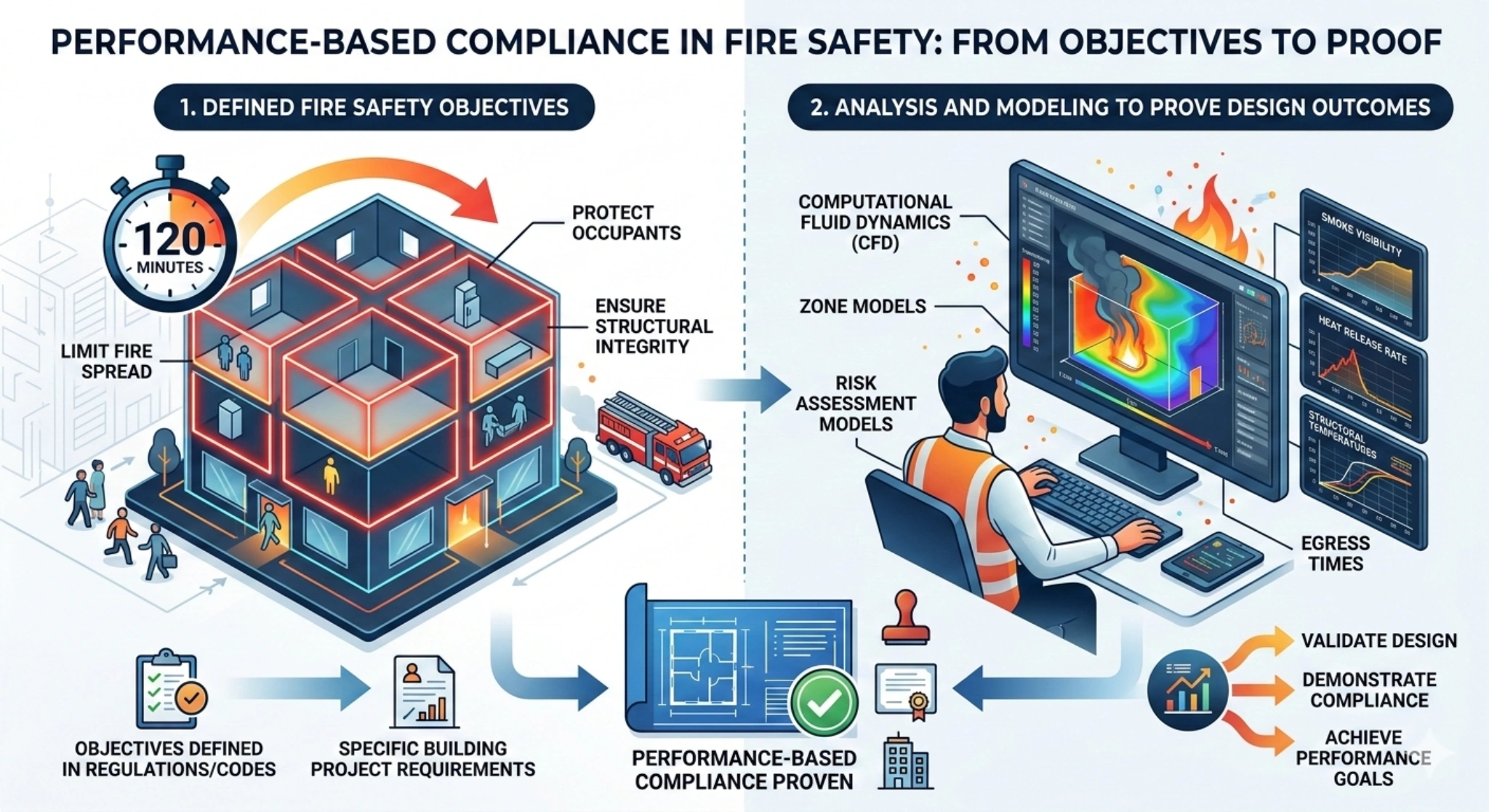
Prescriptive compliance follows the building code’s set requirements, such as specific fire ratings for walls or minimum separation distances between openings. Performance-based compliance starts from defined fire safety objectives, like limiting fire spread beyond a compartment for 120 minutes and then uses analysis and modelling to prove that the proposed design will achieve those outcomes.
For a building manager, the key differences are:
The manager’s role is not to redo the engineering but to understand where the design departs from standard details and to preserve those features in operations and fit-outs.
To manage a performance-based building effectively, managers obtain a clear and structured handover package at completion. At a minimum, this should include:
Where possible, managers should request a digital model or database so changes can be tracked over the life of the asset.
Performance-based fire strategies often depend on specific compartment layouts, protected shafts and carefully detailed penetrations. Uncontrolled tenant works can quickly undermine compliance. Building managers should implement:
- A formal fit-out review process that flags any proposed works affecting fire-rated walls, floors, ceilings, doors or façades
- A requirement for fire-stopping submittals and photographic records before and after any penetration works
- Clear restrictions on using untested combinations of materials or off-label firestopping products
Operationally, staff should be briefed on critical elements that must not be altered, such as fire-rated glazing, ventilated façades with cavity barriers or smoke control interfaces at atria. Any change to the use pattern that affects occupant load or storage of combustibles should trigger a review against the original fire engineering assumptions.
Compliance is not fixed at handover. For complex performance-based passive fire protection, it’s suggested that managers:
If audits reveal repeated nonconformances or if major refurbishments are planned, the original fire engineer or an independent successor should review whether the performance-based strategy is still valid under current codes and building use.
Embarking on a performance-based passive fire protection strategy requires more than selecting products with test reports. It demands a coordinated team, a clear brief and a structured process that stands up to code scrutiny and real-world fire scenarios. Project teams treat this as a defined workstream, not an informal add-on to conventional code compliance.
The most successful journeys start early in concept design, when geometry, materials and systems can still be influenced. Waiting until late stages typically results in compromises, higher cost and increased approval risk. The following roles and steps provide a practical roadmap for complex projects.
Performance-based PFP design blends architecture, engineering, materials science and code interpretation. No single discipline can cover all aspects, so identifying the right contributors is critical.
The core team should include:
For projects with complex façades, unusual occupancies or critical infrastructure, a façade engineer, a fire testing specialist and the PFP system manufacturer or supplier should also be involved.
Before any modelling or detailed design, the team should translate regulatory requirements and project goals into explicit performance criteria. This usually includes target fire resistance ratings for structural elements, compartmentation objectives, tenability criteria for occupants and protection levels for critical services.
Teams should document:
These criteria form the benchmark against which all PFP solutions are assessed. They also ensure that value engineering decisions do not quietly erode safety margins.
Once objectives are fixed, the technical process can begin in a structured way.
First, the fire engineer develops the fire and evacuation strategy for the whole building, including smoke movement and interaction with active systems. This strategy sets the context for where passive measures must perform independently and where they can rely on detection or suppression.
Second, the design team maps all fire and smoke compartments, structural fire zones and critical penetrations using coordinated models. At this stage, specialists recommend identifying every interface where PFP must accommodate movement, moisture or acoustic requirements to avoid later clashes.
The third potential PFP systems are shortlisted with input from manufacturers. For each location, the team should verify that available test data, assessments or engineering judgements match the project’s specific substrates, dimensions and installation details, not just generic ratings.
Finally, the performance-based case is documented and peer-reviewed where required. This includes underlying assumptions, calculation methods or simulations, installation specifications and inspection plans. A clear link between design intent and site quality control is essential so that the completed building actually meets the modelled performance.
What matters is not simply that a building passes inspection, but that the passive systems perform as intended in real conditions and remain reliable as the asset changes over time. Performance-based passive fire protection helps teams deal with complex geometry, mixed-use constraints, existing fabric and newer materials by defining clear objectives and proving outcomes, rather than relying on assumptions baked into prescriptive tables. When it is properly documented, peer-reviewed where required and carried through site quality control, it reduces late-stage redesign, prevents coordination failures and gives certifiers a clearer line of evidence. The result is a fire strategy that supports architectural ambition and sustainability goals without trading away safety, maintainability or long-term compliance.