

What Is a Fire Safety Schedule in NSW? A Guide for Building Owners
September 2, 2026
Fire safety obligations in New South Wales are governed by a statewide legislative framework, although council lodgement procedures, fees and administrative requirements may differ. At the centre of this framework is the fire safety schedule, a statutory document identifying the essential and critical fire safety measures that apply to a building and the minimum performance standard each measure must achieve.
These measures may include active systems such as sprinklers and fire alarms, along with passive fire protection features such as fire doors, fire-resistant construction and protected service penetrations. Together, they help contain fire and smoke, support safe evacuation and protect occupants during an emergency.
IECC recommends that owners, owners corporations and building managers understand exactly what their current fire safety schedule requires. Treating the schedule as the formal reference point for maintenance, certification and annual fire safety statements can support safer buildings and more reliable long-term compliance.
A fire safety schedule is a formal document that lists the essential and critical fire safety measures applying to a building. It also records the minimum standard of performance for each measure. This is the standard to which the measure must be designed, installed and capable of operating.
The schedule deals with the building as a whole and may identify both existing and proposed measures. It is tailored to the building’s use, design and risk profile rather than serving as a generic checklist of fire protection equipment.
It is also important to distinguish required measures from equipment that happens to be present. A fire safety schedule is not necessarily an inventory of every fire-related item installed on the premises. It records the measures that formally apply under the relevant approval, certificate, order or undertaking.
Since 1 August 2023, new fire safety schedules have had to use the standard NSW Government template. The current version of the template must be used when a new schedule is issued or when an existing schedule is reissued in circumstances covered by the legislation. Building Commission NSW publishes the current approved Fire Safety Schedule template for schedules that must be issued or reissued using the standard form.
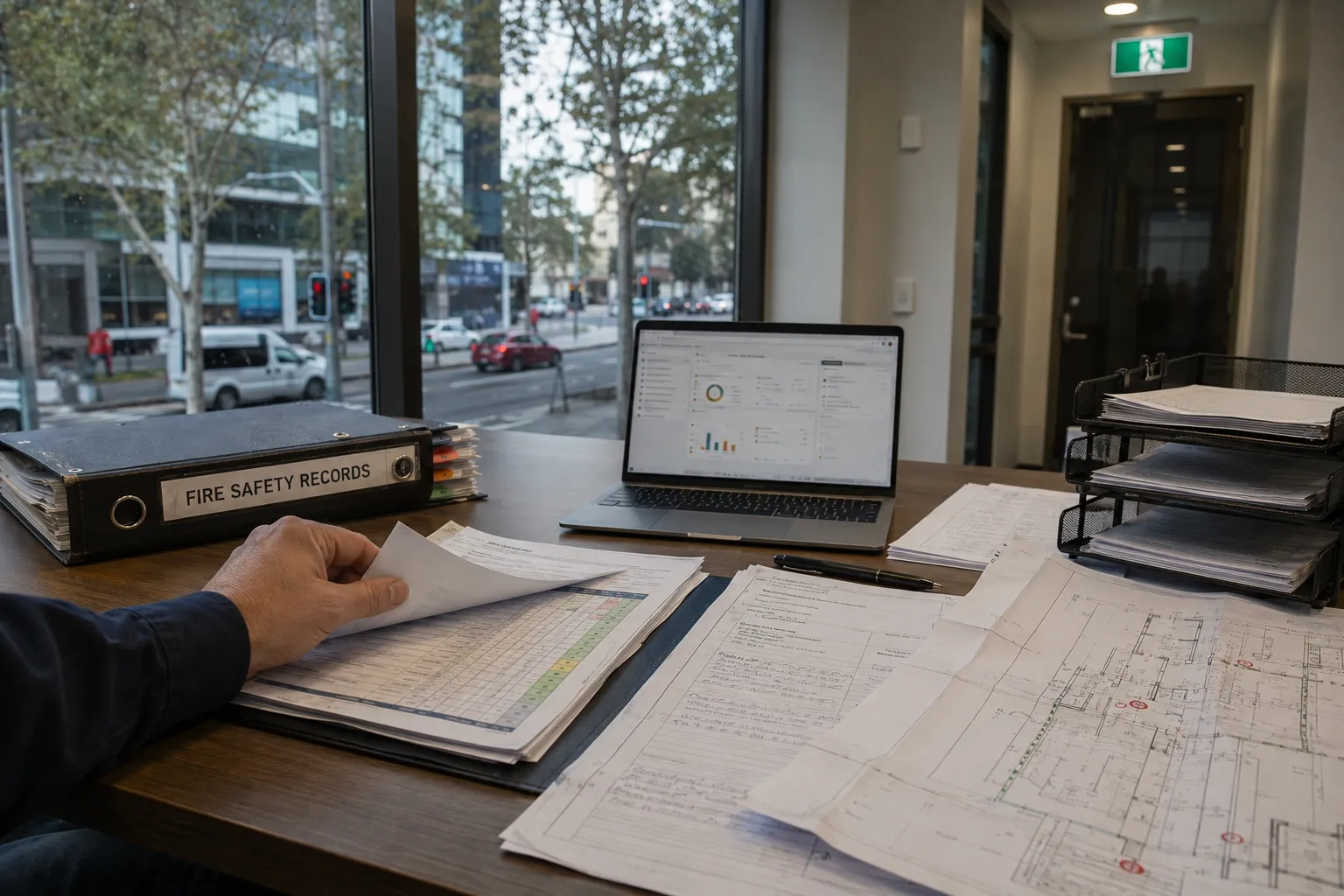
The schedule combines building and approval information with a detailed list of the applicable fire safety measures. The exact contents depend on the property and the authority under which the schedule is issued.
A schedule generally contains information that connects it to the correct premises and statutory approval. This may include:
These details help owners, contractors, practitioners and regulators confirm that they are working from the correct document.
The central part of the schedule lists the fire safety measures that apply to the building. Depending on the design and use of the premises, these may include:
Not every building will contain every measure. The required measures are determined by the building’s approval history, classification, design and any applicable fire safety order or undertaking.
Each listed measure must be accompanied by its minimum standard of performance. This may refer to a provision of the National Construction Code, an Australian Standard, an approved performance solution or another specific requirement.
The standard must be described with enough precision for a practitioner to determine what the measure is expected to achieve. A broad or incomplete reference can create uncertainty when the measure is later assessed for an annual fire safety statement.
A fire safety schedule does not ordinarily prescribe routine servicing intervals for every measure. Routine inspection, testing and maintenance frequencies are generally established by the applicable maintenance requirements, including AS 1851-2012 where it addresses the relevant activity. If a measure is classified as a critical fire safety measure, the schedule also specifies how frequently a supplementary fire safety statement must be issued for that measure.
A fire safety schedule is issued by a council, registered certifier or another authorised person or authority in defined circumstances. Under the current NSW framework, this occurs when the relevant authority:
For new or altered building work, the schedule establishes which fire safety measures must be installed and the standards those measures must achieve. Once the work is complete, the building owner generally issues a fire safety certificate confirming that the new or altered measures have been properly installed and are capable of performing to the required standard. That certificate is part of the process leading to occupation, but it is different from the fire safety schedule itself.
A schedule may need to change when approved work or a formal regulatory action alters the fire safety requirements applying to the building. Common examples include:
The updated requirements must be addressed through the appropriate approval or enforcement pathway. A building owner, maintenance contractor or accredited practitioner cannot simply edit the schedule or treat a working list as a replacement for the formally issued document.
An older Australian Standard appearing on a schedule is not, by itself, evidence that the schedule is wrong. The nominated standard may remain the legally applicable minimum performance standard because it was specified when the relevant approval or order was issued. A newer edition does not automatically replace the standard recorded on the schedule.
Once a fire safety schedule applies to a building, the owner has ongoing responsibilities for the required measures. Appointing a building manager, strata manager or contractor can assist with administration, but it does not remove the owner’s underlying statutory obligations.
Every applicable fire safety measure must be maintained so that it remains capable of performing to the required standard. This includes arranging routine inspections, testing, servicing and repairs by people with the appropriate qualifications, licences and competence for the work involved.
From 13 February 2026, essential fire safety measures in NSW Class 1b and Class 2 to Class 9 buildings must be maintained in accordance with the procedures in AS 1851-2012 where the standard addresses the relevant maintenance activity. Where AS 1851-2012 does not address a measure or activity, another applicable requirement or approved performance solution may govern the maintenance procedure. Building owners can review the AS 1851-2012 maintenance requirements that apply to passive fire systems, including inspection procedures, record-keeping and common rectification work.
Routine maintenance and annual fire safety assessment are related but distinct functions. A technician who services equipment is not automatically authorised to assess and verify that measure for an annual fire safety statement. The owner must ensure that each person engaged has the appropriate authority and competence for the particular task.
Owners should retain clear records of inspections, test results, service reports, defects and completed repairs. Accurate documentation helps the accredited practitioner understand the maintenance history and allows unresolved issues to be identified before the annual statement is due.
NSW Government guidance requires building owners to retain maintenance records for at least seven years and make them available for inspection.
Records should also identify changes to the building or its fire safety systems. Installing new equipment does not automatically amend the schedule, so proposed alterations should be reviewed through the appropriate approval process before work proceeds.
Fire safety compliance extends beyond mechanical and electrical equipment. Required exits and paths of travel must remain available and compliant. Fire doors should not be wedged open, exit routes should not be obstructed by storage or furniture, and exit doors must operate as required while the building is occupied.
Changes to layouts, tenancies, uses or occupant numbers should be reviewed before they are implemented. A new partition, locked door, storage area or tenancy arrangement can interfere with an approved exit system even when no fire protection equipment is removed.
Where an annual or supplementary fire safety statement is required, the owner must ensure it is issued using the approved form. Copies must be provided to the local council and Fire and Rescue NSW in accordance with the Regulation.
The current fire safety statement and fire safety schedule must also be prominently displayed in the building. Owners should confirm any applicable council lodgement procedure, fee and due date while recognising that the underlying obligations arise from NSW legislation.
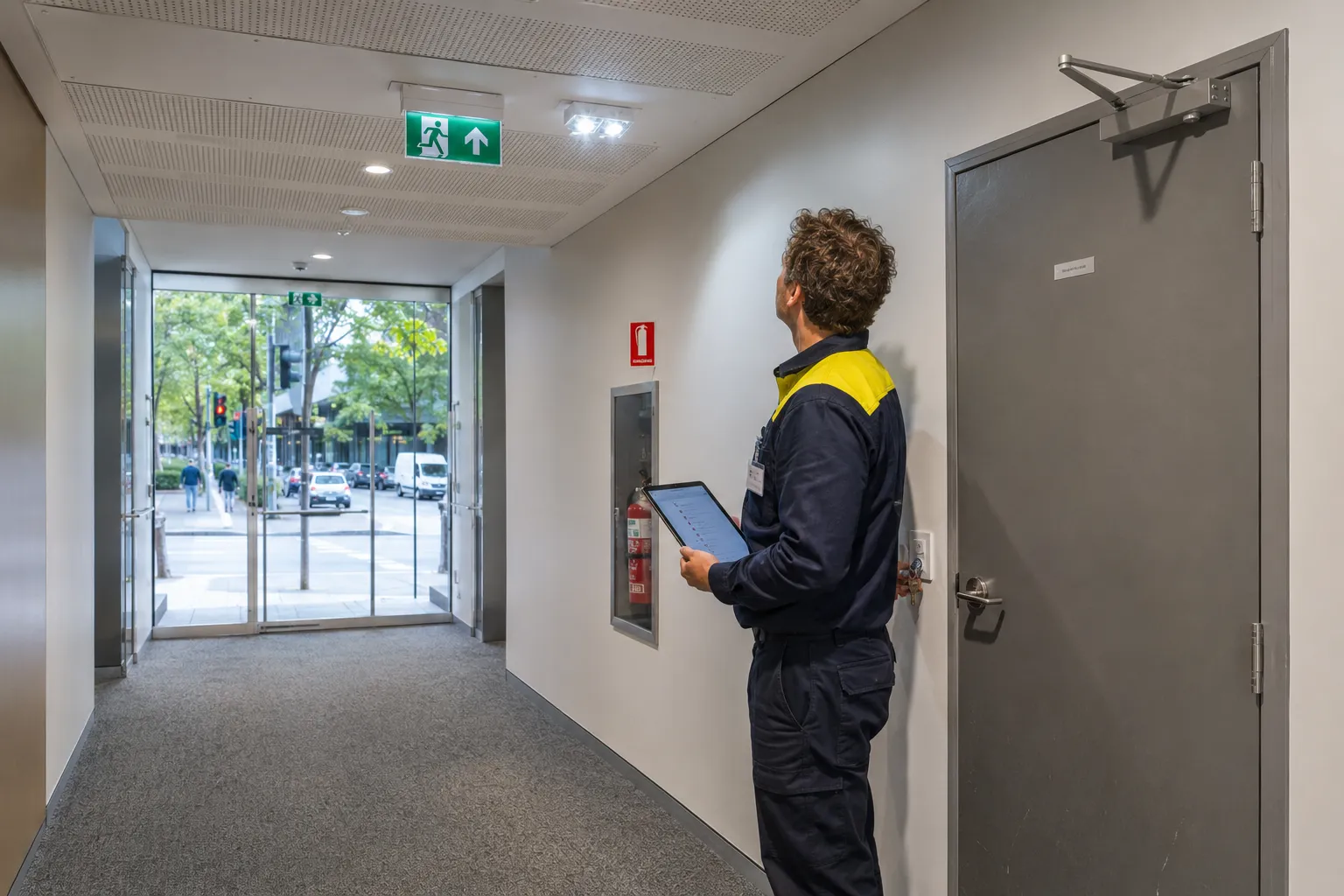
The fire safety schedule establishes the measures and performance standards applying to the building. The Annual Fire Safety Statement, commonly called an AFSS, is the owner’s annual declaration that the required assessment and inspection process has been completed.
An Annual Fire Safety Statement assessment uses the schedule as its reference point when determining which measures must be inspected and the performance standards they must satisfy.
For each essential fire safety measure, an appropriately accredited practitioner must assess the measure and verify that it is capable of performing to at least the standard specified in the schedule. The practitioner must also inspect the building’s exit systems and determine whether their condition discloses grounds for prosecution under the relevant provisions of the Regulation.
The owner or an authorised person acting on the owner’s behalf issues the statement. The accredited practitioners provide the technical assessments and required declarations supporting it. Routine service records or individual certificates for equipment do not replace the annual fire safety statement.
The assessment can also need to address an original measure that applies to an older building even if that measure is not recorded on a modern fire safety schedule. In that situation, the relevant benchmark is generally the standard to which the original measure was designed and implemented. This is one reason the building’s approval history should be examined rather than relying solely on a visual inspection or a current equipment list.
A critical fire safety measure is also an essential fire safety measure, but it requires assessment and certification more frequently than once every 12 months. The required interval is recorded in the fire safety schedule.
The owner must issue a supplementary fire safety statement for each applicable critical measure at the specified interval. This requirement operates in addition to the annual statement and should be included in the building’s compliance calendar.
A missing schedule should be addressed promptly because it can prevent the owner and practitioners from confirming the measures and performance standards that apply.
The owner should first check the building’s records and contact the local council or the certifier connected with the relevant approval. Copies of the development consent, construction certificate, complying development certificate, occupation documentation, fire safety certificates and previous orders may help identify the schedule and the building’s fire safety history.
NSW legislation allows a schedule to be reissued in limited circumstances, including where it has been lost or destroyed. A council or eligible registered certifier must undertake the formal reissue process. A fire safety consultant or building surveyor may help investigate the records and recommend appropriate content, but that adviser cannot independently create a legally effective replacement schedule.
An apparent error should be investigated against the original approvals, plans, certificates, orders and the systems present at the property. Examples may include an incorrect property description, an omission from the issued document or a measure that does not correspond with the relevant approval.
Reissue provisions are not a general mechanism for rewriting a schedule. They cannot ordinarily be used to remove or add measures simply because building work has occurred or the owner prefers a different requirement. If the discrepancy results from alterations, changed plans, unapproved work or a change of use, a new approval, certificate, order or other formal compliance process may be necessary.
Owners should avoid instructing maintenance contractors to disregard a listed measure while the discrepancy is being investigated. The safest approach is to obtain advice from the issuing authority and appropriately qualified building and fire safety professionals, then document the steps being taken to resolve the issue.
Several administrative and practical mistakes can undermine an otherwise sound compliance program:
A controlled document register can help prevent these problems. It should identify the current schedule, annual and supplementary statement dates, responsible contacts, maintenance records and any open defects or proposed alterations.
An accurate fire safety schedule provides building owners and managers with a clear basis for maintaining essential measures, arranging assessments and completing annual or supplementary statements. Any missing documentation, unexplained discrepancy or proposed alteration should be investigated through the appropriate approval or reissue process rather than corrected informally.
IECC can assist owners, owners corporations and building managers in reviewing existing fire safety documentation, identifying potential inconsistencies and determining when further advice from a council, certifier or specialist practitioner is required. Careful document management and timely professional guidance can support safer buildings, clearer maintenance programs and reliable long-term compliance.