

Prefabricated and Modular Passive Fire Systems: Unlocking Next-Gen Strata & Industrial Compliance
March 4, 2026
Prefabricated and modular passive fire systems are reshaping how strata and industrial assets achieve compliance. As project teams navigate evolving standards across building codes, fire regulations and energy frameworks, the traditional site-built approach to fire protection is struggling to keep pace. IECC is seeing a decisive shift towards factory-engineered fire-rated walls, shafts, penetrations and compartmentation elements that arrive on site ready to install with performance characteristics already validated and documented.
In this article we explore how prefabricated and modular passive fire solutions unlock next-generation compliance outcomes for strata developments, mixed-use assets and complex industrial facilities. You will see how offsite manufacturing supports more reliable fire-resistance performance, simplifies certification and inspection and reduces coordination risk between trades. The discussion will cover integration with structural and services design, the role of digital engineering and quality control in the factory environment and the sustainability benefits that flow from material efficiency and reduced rework. Designers, contractors and facility managers will understand how to leverage these systems to achieve future-ready buildings.
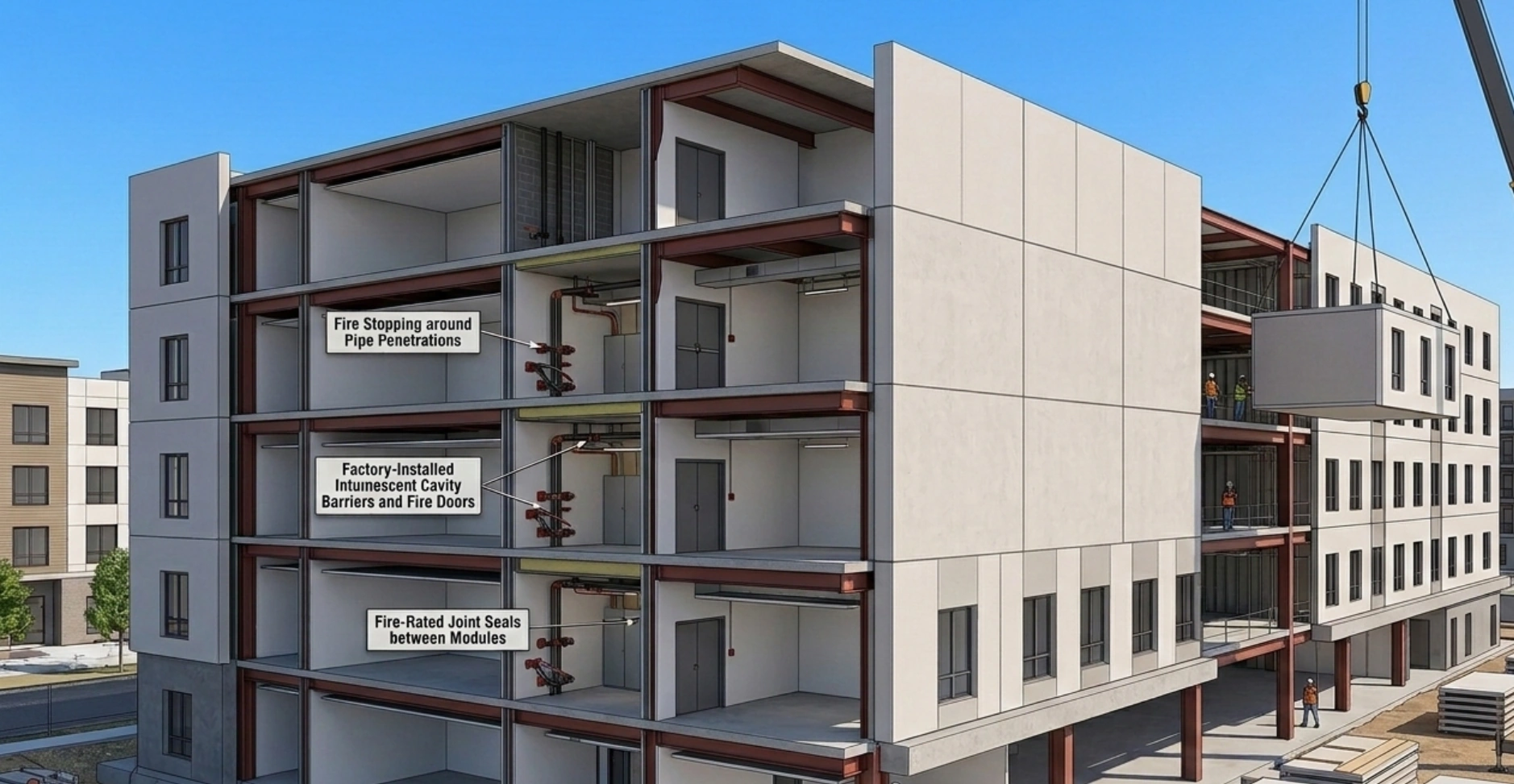
Prefabricated and modular passive fire systems are factory‑manufactured fire-protection elements that arrive on site ready to install with known fire ratings and performance characteristics. Instead of building walls, penetrations, fire‑rated ceilings or enclosures piece by piece on site, contractors use pre‑engineered assemblies that have already been tested and certified to meet relevant codes and standards.
For strata and industrial projects, this approach shifts a large part of compliance from the construction site into a controlled manufacturing environment. Experts use these systems to reduce installation variables, simplify inspections and help building owners achieve predictable fire performance across large portfolios.
A prefabricated passive fire system is designed, detailed and partially or fully assembled off-site. Typical examples are the following:
Each unit is manufactured using specific boards, insulation, framing and fixings that match the tested fire design. Because the build‑up is standardised and repeatable, the fire rating is tied to a tested assembly rather than the variable workmanship of a different site team on every project.
Quality control is a defining feature. Cutting, sealing and lining are carried out using controlled processes, documented batch materials and routine inspections. This reduces common failure points such as gaps in linings, missing sealant or incorrect fasteners, which frequently appear in on‑site fire audits.
Modular passive fire systems take the prefabrication concept further by using repeatable components that can be combined like building blocks to suit different layouts and occupancies. Instead of a one‑off detailed wall or plantroom enclosure, the design is broken into modules with defined interfaces and capacities.
In strata and industrial settings, this often includes:
The key is that each module has a known fire resistance level and clear installation rules. Designers can configure corridors, riser stacks and plant rooms from these modules while retaining compliance with the tested system. For managers, this simplifies future alterations because additional services can pass through dedicated prefabricated zones without cutting into primary fire barriers.
Traditional passive fire protection relies heavily on bespoke details created and installed on site. Performance can vary from floor to floor depending on who installed the framing, sheeting and fire-stopping. Prefabricated and modular systems replace many of these bespoke details with pre‑approved assemblies backed by third‑party testing.
For strata and industrial projects, this delivers three practical benefits. First, it shortens programme time because fire‑rated elements arrive ready to be fixed into position with minimal wet trades. Second, it improves documentation because each unit carries clear test references, material schedules and installation instructions. Third, it creates a consistent baseline for inspections and ongoing maintenance, which is crucial for demonstrating compliance over the life of the asset.
The Australian compliance framework for modular passive fire protection is tightly regulated and increasingly scrutinised, particularly in strata, industrial and mixed-use projects. Anyone considering prefabricated or modular fire systems must understand that approval hinges on proven fire performance, traceable evidence and correct installation pathways under the National Construction Code (NCC).
Specialists operate within this framework by aligning modular PFP solutions with the NCC, relevant standards and the expectations of certifiers and fire authorities so that off-site innovation still fits neatly within onsite compliance requirements.
The NCC sets the fire performance objectives that modular PFP must meet. For strata and industrial assets, the critical elements are:
Modular fire-rated walls, riser shafts, service pods and prefabricated penetrations must demonstrate that their assembled systems achieve the relevant FRL when integrated into the building’s construction type. It is not sufficient that individual components are fire-rated in isolation.
Australian standards define how PFP performance is proven. For modular systems, the key standards are typically:
Modular PFP often uses a “system-tested” approach. Where a project-specific configuration varies from the test, an engineering assessment in line with NCC and fire authority expectations is required.
NCC Part A5 covers the documentation used to demonstrate that passive fire systems meet the Performance Requirements, which is especially important for modular PFP. For prefabricated systems, project teams typically provide:
On site, the modular nature of the system does not remove the need for correct installation. Builders and subcontractors must follow the tested or assessed details exactly, including fixings, tolerances, gap sizes, and sealant types, so the certifier can verify the installation against the supporting evidence. Any deviation from the tested or assessed design usually requires updated documentation or a revised assessment before certification and occupancy approval can be issued.
In high-density strata and multi-tenant industrial facilities, fire separation has to adapt to frequent layout changes, service upgrades and tight construction programmes. Prefabricated and modular passive fire systems allow experts to deliver compliant compartmentation with less disruption to occupants and clearer traceability for certifiers. The focus is on repeatable details, fast installation and easy future modification without compromising fire ratings.
Modular firewalls, riser and shaft barriers and pre-tested service penetration systems can be selected, configured and installed in a predictable way that aligns with standards while supporting Green Star or other performance targets.
In strata residential and mixed-use buildings, modular barriers are particularly effective in:
In multi-tenant industrial buildings and business parks, the same principles apply to tenancy-demising walls, shared loading docks, office pods inside warehouses and high-bay storage zones.
For riser and shaft applications, prefabricated fire-rated enclosures and pre-formed floor penetration modules support rapid service installation. Panels are sized to standard shaft grids so future additions or reconfigurations can be managed by swapping modules rather than rebuilding walls.
Successful deployment in high-density buildings depends on early planning. Specialists coordinate with architects, services, engineers and strata or asset managers to:
In occupied strata buildings, installation staging is critical. Prefabricated barriers are brought in as small, manageable components to minimise disturbance in corridors and lobbies. Work is sequenced floor by floor or zone by zone outside peak occupant hours and with temporary containment to control dust and noise.
Modular barriers must be fully verifiable. Documentation should link each barrier type to its fire test reports, installation instructions and as-built location. Tags or QR labels on barriers and penetration modules allow facilities managers and fire certifiers to confirm ratings during inspections.
As tenancies merge or subdivide, modular systems allow fire compartments to be adjusted with minimal demolition. Panels can be removed, relocated or supplemented, and service openings can be resized using compatible tested components. This supports long-term compliance for dynamic portfolios without repeated redesign and invasive work.
Retrofitting existing warehouses and commercial buildings with compliant passive fire systems is often seen as disruptive and slow. Prefabricated and modular solutions change that assumption by compressing installation time, limiting shutdowns and simplifying compliance upgrades to current code and strata requirements. Experts focus on systems that can be installed around ongoing operations so sites stay productive while risk is reduced.
Instead of cutting and fabricating on-site, modular firewalls, ceilings and penetration seals arrive pre-engineered to suit measured openings and known fire ratings. This reduces unknowns during construction and helps building owners move quickly from audit findings to certified rectification with clear documentation for insurers and regulators.
For distribution centres, cold storage and multi-tenant commercial buildings, the main concern is how long areas need to be taken offline. Prefabricated fire-rated wall panels, ceiling cassettes and shaft linings are designed for rapid fix-off using preset connection details and compatible sealants. Installers can complete fire compartmentation upgrades during short night or weekend windows.
In practice, this means that large sections of racking do not need to be dismantled for long periods because fire barriers can be installed in sequence bay by bay. In commercial sites, plant rooms, risers and ceiling voids can be upgraded in stages so tenants keep trading while specialists work in defined zones. Less cutting, grinding and wet trades on site also reduce clean-up time, which is critical in operational logistics and food facilities.
Retrofitting into older warehouses or mixed-use commercial shells is often complex because of unknown substrate conditions and previous alterations. Modular passive fire systems address this with tested interface details for steel frames, tilt panels, precast concrete and lightweight partitions. Preformed collars, wraps and boards for service penetrations are sized to common duct and pipe diameters so installers are not fabricating ad hoc solutions in the ceiling void.
It begins with a digital survey or as-built review, then aligns prefabricated components with the existing structure and services. For example, modular fire damper sleeves and access panels can be coordinated with HVAC layouts so installers cut once and fit tested assemblies rather than building fire protection piece by piece. This reduces coordination clashes and makes it simpler to provide a compliance pack that matches what is actually on site.
Traditional on-site built fire upgrades often result in inconsistent detailing that is hard to certify and even harder to modify later. Prefabricated and modular systems are supplied as part of a tested system, which means fire resistance levels and installation methods are clearly documented. Inspectors and strata managers can reference manufacturer data aligned with the installed product, which speeds up approvals and annual fire safety statements.
For warehouses that frequently reconfigure racking or create new mezzanines, modular fire barriers and penetration systems can be removed and reinstated without damaging the base building. Commercial landlords benefit from standardised solutions across multiple tenancies, so each fitout only needs targeted adjustments to existing fire stopping instead of a full rework.
Many non‑compliances in strata and industrial projects occur at the interfaces where trades, products and documentation meet. Prefabricated and modular passive fire systems reduce these gaps by locking in tested details off-site so the installation team follows a controlled, repeatable process. When combined with clear documentation and inspection, they can improve alignment with NCC, AS 1530 and AS 4072 requirements.
Professionals use prefabrication to convert complex onsite firestopping decisions into simple, install‑to‑the‑line tasks. This approach targets the most common failure points, such as inconsistent detailing around services, penetrations through fire‑rated elements and missing evidence of performance.
Service penetrations remain the single largest source of passive fire non‑compliance. On traditional builds, different trades cut their own openings, then attempt to firestop them with incompatible products. Prefabricated PFP instead groups services into coordinated, factory‑built modules sized and tested as a complete assembly.
For example, pre‑engineered service riser cassettes or modular service pods are designed around the actual mix of electrical, hydraulic and mechanical services. The opening size, edge distances, sealant type and collar or wrap selection are all based on specific test reports or assessments. On-site, the contractor installs the cassette or pod into the fire‑rated shaft or wall and only has to seal the pre‑defined interfaces.
This approach avoids common issues such as oversized or irregular openings, mixed manufacturers in one penetration, unprotected plastic pipes or data bundles passing through ad hoc holes. It also simplifies coordination with mechanical and electrical engineers because the tested configuration becomes part of the design set, not a late-site decision.
In strata and industrial projects, the same detail may be repeated hundreds of times. Small variations in workmanship often lead to systemic non-compliance. Prefabricated and modular assemblies introduce a high degree of uniformity because critical fire-resisting components are manufactured to a controlled specification.
Project-specific installation drawings and checklists should reference the exact system ID and test report for each repeated detail. This makes it easier for building surveyors and certifiers to confirm that what is on site matches what has been approved, and for facilities managers to maintain those systems over the building’s life.
Another common compliance gap is poor documentation. Products may be correctly installed but lack clear traceability to test reports or assessments. Prefabricated PFP assemblies address this through integrated labelling and digital records.
Each module or kit can arrive with a unique identification that links to:
Certifiers and insurers can then verify compliance without guesswork or intrusive investigations. This approach is valuable in complex strata ownership structures or large industrial estates where clear as‑built documentation is essential for future refurbishments and change of use.
Selecting a modular passive fire protection partner is now as critical as choosing a structural engineer or fire engineer. The right choice can shorten programmes, de‑risk compliance and simplify future refurbishments, while the wrong partner can lock a building into long‑term defects and unplanned costs.
It’s recommended that building managers approach modular PFP selection as a structured due diligence exercise focused on evidence, not marketing claims. The following questions help distinguish genuine competence from commodity supply.
A credible modular PFP partner must provide third‑party test reports and listings that match real site conditions. Building managers should ask for test data that shows:
If the partner relies heavily on engineering judgements, building managers should request the basis of those judgments and ensure they are issued by competent fire engineers.
Modular PFP succeeds or fails in the coordination phase. A suitable partner should provide early design support with standard detail libraries, BIM‑ready content and clash‑detection input so service routes and modular fire elements align before construction.
During installation, the partner should offer clear installation manuals, trade training and site inspections at critical milestones. In multi‑trade environments, experts look for partners that can act as a single coordination point for fire‑stopping of mechanical, electrical, hydraulic and data services so accountability is unambiguous.
Building managers should ask who is responsible for on‑site adaptations when penetrations differ from drawings and how those changes are documented so there is no gap between design intent and as‑built reality.
A capable partner should deliver a complete digital record set, including tested system references, installation photos, locations and product data that can be handed to strata committees, insurers and regulators.
Confirm the following:
For strata and industrial portfolios, building managers should also check if the partner can support portfolio‑level asset registers so PFP information across multiple buildings remains consistent and auditable over the life of the assets.
Prefabricated and modular passive fire systems are no longer experimental options; they are fast becoming the operational backbone of compliant strata and industrial assets. By shifting fire protection into a controlled, factory‑driven process, these systems compress project timelines, reduce onsite risk and deliver a level of installation accuracy that traditional trades struggle to match. This combination translates into fewer defects, fewer disputes, lower lifecycle costs and a more defensible position. It also creates a scalable blueprint: standardised firestopping details, repeatable modules and digital records that span from design through to asset operations, making portfolio‑wide compliance and ESG reporting more achievable.