

When Are Fire Collars Required for Pipe Penetrations?
October 9, 2026
Fire collars help maintain fire compartmentation where pipes pass through fire-rated walls and floors. Selecting the right firestop system helps prevent penetrations from becoming weak points during a fire, supports compliance and avoids costly rework.
For projects involving passive fire protection in Sydney, factors like pipe material, size, wall or floor construction and the required fire-resistance rating can determine whether a fire collar or another tested firestop solution is appropriate. Correct positioning, installation and ongoing maintenance are also essential to maintaining the intended performance.
IECC provides firestop solutions designed to address these requirements across different service penetrations. Key considerations include building requirements, pipe types, positioning, tested systems, installation issues and ongoing inspection.
Fire collar requirements are influenced by the National Construction Code (NCC), the fire-resistance level of the building element and the tested firestop system used for the penetration. These requirements determine how service penetrations through fire-resisting construction need to be protected and whether a fire collar or another firestop solution is appropriate.
Under NCC Volume One, C4D15 addresses openings for service installations where plumbing, mechanical, electrical or other services penetrate building elements required to have an FRL with respect to integrity or insulation, or resistance to the incipient spread of fire. For tested systems, the service, building element and protection method must correspond with an appropriate prototype assembly tested in accordance with AS 4072.1 and AS 1530.4, subject to the permitted variations in AS 4072.1.
The NCC requires service penetrations through relevant fire-resisting building elements to maintain the required fire performance. This means a pipe penetration cannot simply be sealed with any fire-rated product. The complete protection method needs to be suitable for the particular service and building element.
The current NCC provisions should be checked for the applicable project because requirements and adoption arrangements can change. NCC 2025 was published in 2026, with states and territories responsible for adoption and transition arrangements.
NSW NCC guidance confirms that NSW will adopt NCC 2025 on 1 May 2027 and that NSW-specific variations must also be considered.
AS 4072.1 provides requirements relating to service penetrations and control joints in fire-resistant separating elements, while AS 1530.4 provides fire-resistance test methods for building construction, including elements penetrated by services. The NCC uses these standards as part of the framework for demonstrating that tested penetration systems achieve the required fire performance.
A fire collar should be considered as part of a complete tested assembly rather than as an isolated product. The approved configuration needs to correspond with the pipe, substrate, fire rating and installation method.
Project drawings, specifications and fire engineering documentation may identify the required fire-resistance levels and approved firestop details for service penetrations. These documents can provide important information when selecting and installing a collar.
NSW’s fire safety reforms also address documentation, certification and maintenance requirements for building fire safety measures.
Where an actual site condition differs from the tested configuration, the system should be reviewed against the relevant product documentation and applicable requirements. An appropriate engineering assessment or alternative compliant system may be required rather than modifying the installation on site.
Fire collars are most commonly associated with combustible pipes that pass through fire-rated walls, floors or other fire-resisting construction. Plastic pipes can soften, deform or burn away when exposed to high temperatures, potentially leaving an opening through the building element.
The need for a collar depends on more than pipe material. Pipe diameter, wall thickness, penetration arrangement, building element and required fire rating can all affect which firestop system is suitable. The relevant tested configuration should be checked before installation.
Plastic pipes are common candidates for fire collars because they can lose their structural form during a fire. Here are some examples:
The required collar can vary between different pipe materials and diameters. A system approved for one type or size of plastic pipe should not automatically be applied to another.
Steel, copper and cast iron pipes behave differently from combustible plastic pipes and may be protected using other firestop methods, such as sealants, mineral fibre, mortar or tested wrap systems.
However, metal pipes can still require specific protection where combustible insulation, coatings or surrounding materials are involved. Some NCC provisions also provide specific treatment for certain metal piping arrangements, subject to conditions.
The appropriate solution should be based on the approved firestop system and the actual penetration configuration rather than assuming that a metal pipe does or does not require a collar.
Fire-rated walls and floors require careful treatment where services pass through them because an unprotected penetration can reduce the fire performance of the separating element. The type of protection depends on the construction, required FRL, pipe and tested firestop arrangement.
A fire collar is only one possible component of the protection system. Some penetrations may use collars, while others may require wraps, sealants, mortar or other tested systems. Non-fire-rated partitions do not create the same firestopping requirement, although other building and service requirements may still apply.
When a pipe penetrates a fire-rated wall, the penetration needs to retain the required fire performance of the wall. Combustible pipes may require an intumescent collar or another approved system that closes or protects the opening as the pipe is affected by heat.
The wall construction can also influence the installation. Lightweight framed walls may have specific requirements for backing, framing, fixing and the surrounding firestop materials that differ from concrete or masonry construction.
Service penetrations through fire-rated floors also need to maintain the required fire performance. Vertical plastic pipes passing through concrete slabs are a common application for fire collars, although the approved mounting arrangement depends on the tested system.
Where a pipe passes through several fire-rated floor levels, each penetration needs to be considered separately. The appropriate firestop detail should be confirmed for each building element rather than assuming that one installation arrangement applies throughout the building.
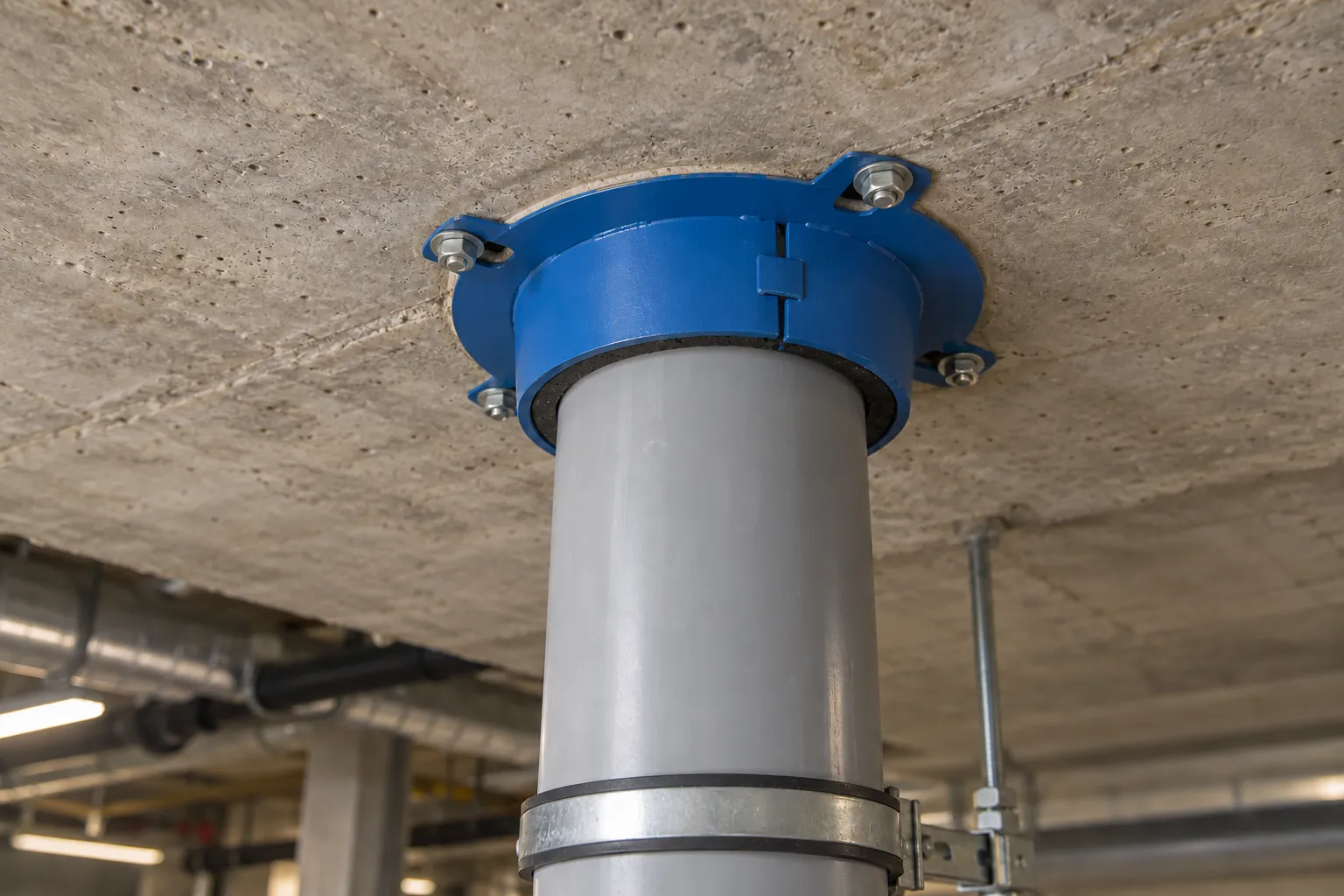
Fire collars should be positioned around the pipe in the location specified by the tested firestop system. The correct position can depend on whether the penetration is through a wall or floor, the pipe configuration, the required fire rating and the manufacturer's installation requirements.
The collar must also be securely fixed so it remains in the intended position and can perform as tested when exposed to fire. It should not be relocated, embedded or installed on another face simply because the alternative position is more convenient.
For wall penetrations, the approved system determines whether the collar is installed on one side or both sides of the wall. It also specifies the required fixing method, fasteners, spacing and any backing or supporting materials.
Lightweight framed walls may require additional installation measures compared with concrete or masonry walls. The collar position should follow the approved firestop detail rather than a general assumption about wall penetrations.
For floor penetrations, collars are commonly installed to the underside of concrete slabs where the tested system specifies this arrangement. However, the exact position depends on the approved system.
A collar should not be moved to the top of the slab or embedded within the floor simply to suit site conditions unless that configuration has been specifically approved.
The space around a penetration can also affect installation. Nearby pipes, cables, structural elements, sleeves and other services may restrict the available space for the collar and associated firestop materials.
Where the actual spacing or clearance differs from the tested configuration, the penetration should be reviewed before installation or modification. A different tested system or appropriate engineering assessment may be required.
Fire collars do not automatically need to be installed on both sides of a wall or floor. The number and position of collars depend on the tested system, pipe configuration, building element and manufacturer's installation requirements.
For fire-rated walls, some tested systems specify protection on one side while others require collars on both sides. For floors, the approved arrangement may specify a collar beneath the slab or another configuration. Where a pipe passes through multiple rated floors, each penetration needs to comply with its relevant firestop detail.
Adding a second collar does not automatically make an installation compliant. If the additional collar, fixing arrangement or position differs from the tested configuration, it may not provide the expected fire performance. The approved system should determine the number, location and installation method.
Pipe size affects fire collar selection because different diameters can create different penetration openings and may respond differently when exposed to fire. The collar must be approved for the specific pipe size and material rather than selected based on a general diameter range.
The penetration itself also matters. Wall or floor construction, substrate thickness, annular gap, sleeves, nearby services and the required fire rating can all affect which system can be used.
Fire collars are tested for specific pipe materials and nominal diameters. A collar approved for a specific PVC pipe should not automatically be used with a different diameter, wall thickness or material.
Larger plastic pipes can create larger openings as they soften or deform, which is why the approved collar size and configuration need to correspond with the pipe being protected.
The surrounding building element can change the suitability of a firestop system. A configuration tested in a concrete floor may not be suitable for a lightweight framed wall, even when the same pipe and collar are used.
Annular gaps, sleeves, insulation and the position of nearby services may also be subject to specific limits. If the actual penetration differs from the approved configuration, another tested system or appropriate assessment may be required.
A fire wrap or another firestopping system can be used instead of a fire collar when that solution has been tested and approved for the particular pipe, penetration and fire-rated building element.
Intumescent wraps may be suitable for certain combustible pipe penetrations, while other systems can use sealants, mortar, mineral fibre, cast-in devices or modular firestop components. The appropriate option depends on the complete tested configuration rather than the appearance or fire rating of an individual product.
The product documentation should confirm the approved pipe type and size, substrate, fire rating, installation position, clearances and other relevant conditions. If the available space or site arrangement does not match the approved system, an alternative tested solution should be considered rather than adapting the product without approval.
A fire collar does not provide its rated performance independently of the surrounding construction. Its performance is established through testing of a specific combination of pipe, protection method, building element and installation arrangement. The same principle applies to penetration sealing, where the complete installation needs to correspond with the tested configuration.
The approved system needs to account for details such as:
Changing one of these details can affect how the system performs when exposed to fire. For example, an intumescent collar relies on the tested combination of the collar and surrounding construction to close or protect the penetration as a combustible pipe deforms.
This is why a product should not be substituted, relocated or modified simply because it appears suitable. Where the site condition differs from the tested configuration, the manufacturer's documentation and applicable requirements should be reviewed to identify an appropriate solution.
Fire collar problems commonly arise from incorrect product selection, unsuitable fixing, poor penetration preparation or changes made after the original firestop system was installed. A collar can be present but still fail to provide the intended protection if the surrounding installation does not match the approved configuration.
Similar passive fire defects can occur elsewhere in existing buildings, particularly where service alterations have affected fire-rated walls, floors or penetration seals.
Beware of these issues:
Inspection records and photographs can help identify changes to firestopping over time. Where a penetration no longer matches the approved configuration, it should be reviewed against the applicable system before being accepted as compliant.
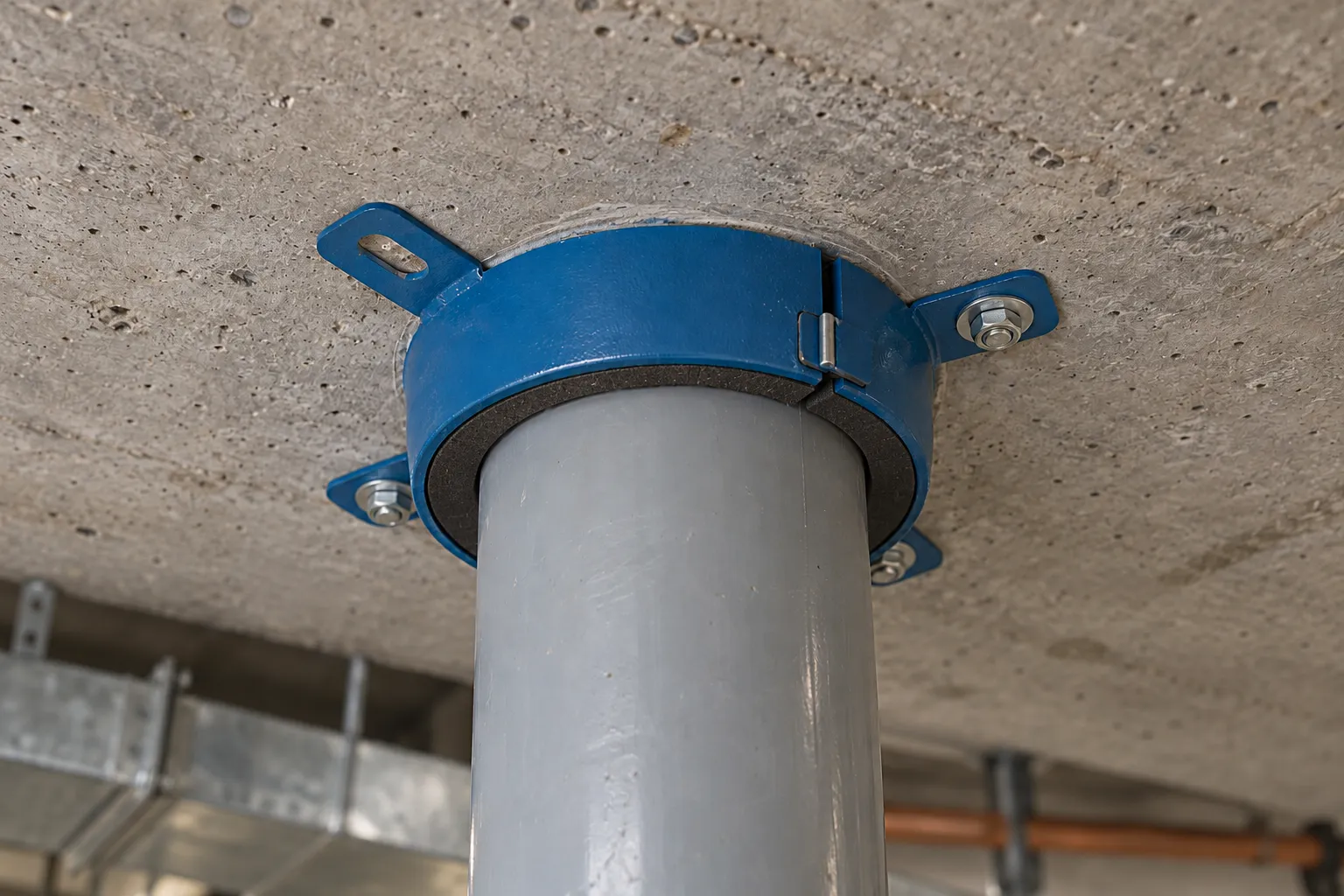
Fire collars should be inspected after installation and periodically checked to ensure they remain secure, undamaged and consistent with the approved firestop system. This is relevant in service risers, plant areas and other locations where plumbing or maintenance work may affect existing penetrations.
A basic inspection should include:
Maintenance work should not involve simply cutting, removing or replacing a fire collar with a similar product. Any alteration should be assessed against the relevant firestop detail so the penetration continues to provide the required protection.
Fire collars help maintain fire resistance where pipes pass through rated walls and floors, with the appropriate solution depending on the pipe, building element, fire rating and tested firestop system. Correct selection and installation are essential for maintaining fire compartmentation and avoiding compliance issues.
IECC provides firestop solutions for pipe penetrations and other passive fire protection requirements. Careful selection, installation and coordination can help ensure fire collars perform as intended while supporting compliant and durable firestopping.