

NSW Fire Safety Changes for 2026: What Building Owners and Strata Managers Need to Know
August 4, 2026
With fire safety reforms set to take effect across New South Wales, building owners, strata managers and facility operators will need to adapt to stricter compliance requirements and evolving safety expectations. These will influence how residential and commercial buildings are maintained and managed, making early planning essential to reduce risk, avoid costly upgrades and protect occupants. As a provider of passive fire protection in Sydney, IECC helps clients prepare for these changes with compliance solutions and industry expertise.
Knowing the new requirements for essential fire safety measures, inspections, certification, documentation and owner responsibilities is key to staying ahead of the reforms. By addressing these obligations early, building owners and managers can strengthen compliance, support safer buildings and minimise the risk of unexpected regulatory issues as the 2026 changes come into effect.
From 13 February 2026, new fire safety obligations affect building owners, strata committees and building managers. These changes tighten responsibilities for fire safety certification, documentation and contractor competence and introduce stronger regulatory oversight of ongoing fire safety maintenance.
The reforms apply across Class 1b to Class 9 buildings and are most visible at two points in the building lifecycle. At occupation through fire safety certificates and annually through fire safety statements. Failure to comply now carries higher penalties and greater enforcement risk.
The NSW building fire safety reforms explain the updated maintenance, certification and practitioner requirements applying to essential fire safety measures.
Fire safety certificates for new buildings and for new or altered fire safety measures must now meet stricter content and evidence standards. Certifiers and building owners must demonstrate that each fire safety measure has been properly designed, installed and tested against the relevant performance criteria.
Annual fire safety statements lodged from 13 February 2026 must include more detailed information about each critical fire safety measure. This includes the date of inspection, the standard of performance applied and any identified non-conformances with rectification timeframes. Template-based or minimal statements that lack measure-by-measure detail are no longer acceptable.
The reforms also require clearer alignment between the fire safety schedule and the measures inspected. Any discrepancy between what is installed and what is listed must be identified and addressed before the statement is signed. Owners are expected to keep supporting records for inspections, testing and maintenance to evidence the declarations made in certificates and statements.
The NSW fire safety certification requirements explain how fire safety certificates, annual fire safety statements and supplementary statements apply to regulated buildings.
Only recognised competent fire safety practitioners may carry out assessment and inspection functions associated with fire safety statements. The reforms strengthen the existing accreditation framework by specifying competency criteria and clarifying that general maintenance contractors without appropriate fire qualifications cannot sign off on critical measures.
Each person who inspects tests or certifies a fire safety measure must now be identified in the documentation together with their accreditation or competency reference. This increases traceability and makes it easier for regulators to investigate poor practice. Signing a statement without appropriate competence or without having properly inspected the measures is treated as a serious offence with higher maximum penalties.
The changes also expand the enforcement tools available to councils and Fire and Rescue NSW. Councils have clearer grounds to issue orders or penalties where annual fire safety statements are late, incomplete, inaccurate or signed by unqualified persons. Repeated non-compliance can trigger more intrusive regulatory action.
In many local government areas, digital lodgement of fire safety certificates and statements through designated online portals became mandatory from this date. Owners must now ensure that documents are submitted in the required electronic format and within specified deadlines. Late lodgement attracts automatic penalty notices and can delay occupation or leasing of affected premises.
The changes tighten fire safety obligations across a wide range of existing and new buildings. The impact is not limited to high‑rise towers. Smaller residential blocks, mixed‑use developments, commercial tenancies and certain public buildings will all face closer scrutiny of fire protection measures and documentation.
The important question is whether a building falls within the categories targeted for upgraded systems, more frequent inspection or stronger performance standards. The answer depends on building classification, age, height, use and whether any refurbishment or change of use is proposed after the new requirements commence.
The reforms primarily target higher-risk and more complex buildings, including Class 2 residential apartment buildings, Class 3 and Class 9 accommodation such as hotels, student housing and aged care facilities and Class 5, 6 and 7 commercial and mixed-use developments.
Multi-unit residential buildings with combustible cladding, interconnected carparks or shared mechanical systems will face the greatest level of scrutiny, while existing buildings undergoing alterations or changes of use may also be required to upgrade fire safety measures.
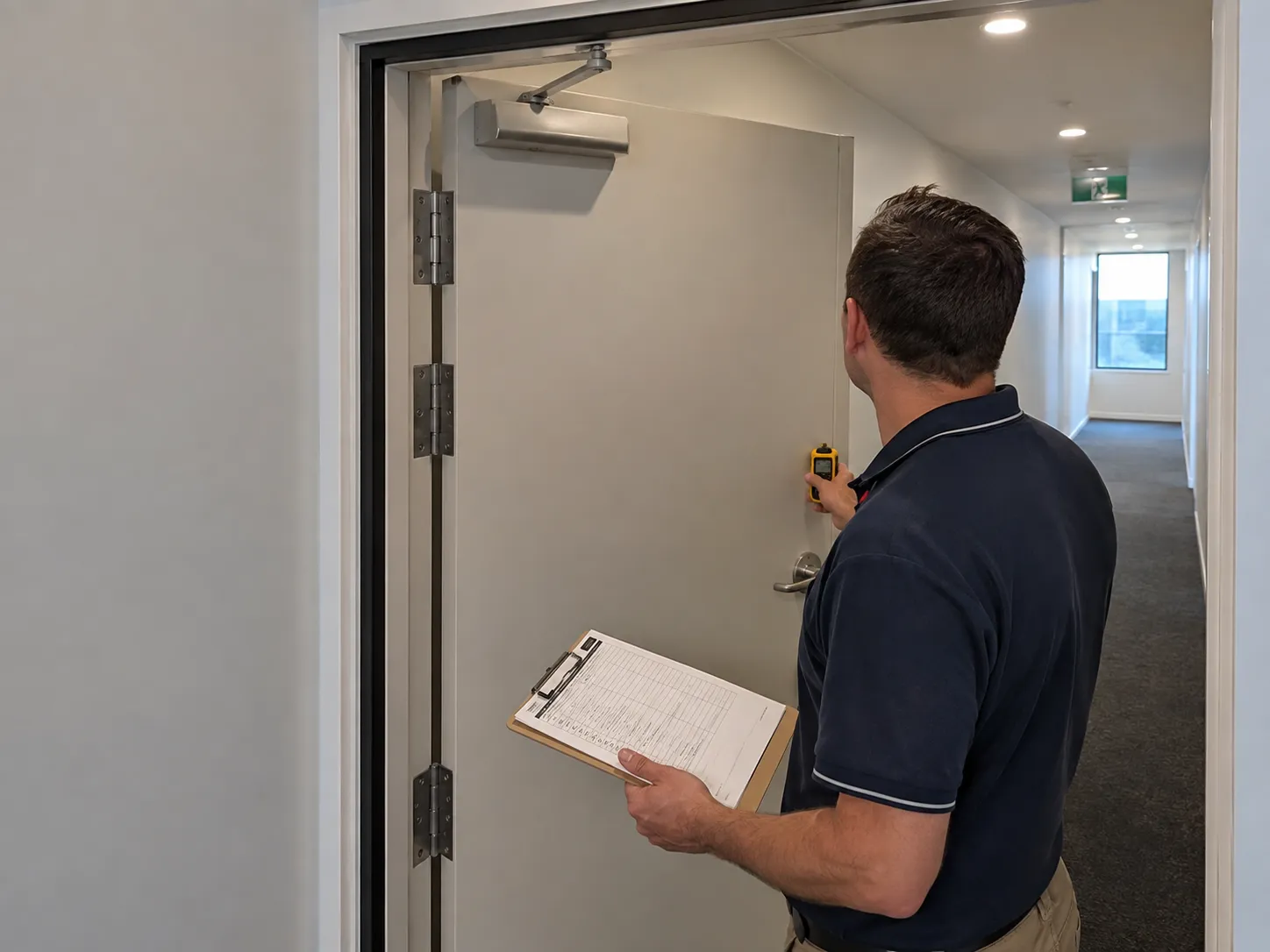
The reforms emphasise how fire safety systems perform in real operating conditions rather than simply confirming they are installed. Regulators will assess automatic sprinkler systems, smoke detection and EWIS systems, fire hydrants and hose reels, fire and smoke doors and fire-resisting construction. In carparks and plant areas, additional attention will also be given to smoke control systems, carbon monoxide monitoring and fire-rated separation between carparks and residential spaces.
Beyond physical systems, much of the reform effort is directed at ongoing maintenance and record-keeping. Annual fire safety statements will be expected to reflect not only that a measure exists but also that it has been tested in accordance with the latest referenced Australian standards.
Strata schemes and commercial owners will need clear asset registers for all essential fire safety measures, accurate plans for fire indicator panels and evacuation routes and evidence that competent fire safety practitioners performed inspections. Any performance solutions in place for sprinkler coverage or alternative smoke control strategies will need contemporary justification and regular review once the new framework takes effect.
Fire safety responsibility will sit more squarely on building owners and owners corporations. Regulators are shifting from a paperwork focus to demonstrable safety performance, which means clearer legal duties, more frequent checks and stronger accountability when things are missed.
Experts will need to understand not only what has to be done but also who is accountable for each task. Delegating work does not transfer the legal duty to maintain a safe building.
Building owners and owners corporations retain the primary legal duty to ensure fire safety measures are designed, installed and maintained to perform as intended. Engaging a fire safety practitioner is mandatory for regulated tasks, but the obligation to choose competent providers and verify work remains with the owner.
Committees should establish clear governance arrangements by documenting fire safety responsibilities. Strong governance records will help demonstrate compliance during regulatory inspections and insurance reviews.
Building owners and strata committees can also prepare for a passive fire compliance audit by reviewing fire doors, fire stopping, compartmentation and supporting records before formal inspections take place.
Regulators are expected to place greater emphasis on evidence of ongoing maintenance rather than a once‑a‑year certification exercise. Owners will be responsible for ensuring that:
Electronic logbooks and digital portals are likely to be favoured by councils and Fire and Rescue NSW because they provide time‑stamped proof of inspections and repairs.
Owners corporations should establish clear rules around storage in common areas, prevent residents and contractors from altering fire doors or interfering with smoke detection and sprinkler systems and provide occupants with regular fire safety information during inductions, annual meetings and major building upgrades.
Access management will also become critical. Fire technicians must be able to reach all fire safety equipment on scheduled dates. Owners corporations may need to adopt by‑laws or lease conditions that require tenants to provide access for inspections and to cooperate with defect rectification work.
AS 1851-2012 sets out how frequently fire protection systems must be inspected, tested and maintained and how those activities must be documented. For NSW property owners and facility managers, it serves as the practical framework that sits behind the annual fire safety statement and the changes are reinforcing closer alignment with this standard.
The standard does not replace design or installation codes. Instead, it focuses on keeping existing systems in working order over the life of the building. Failure to follow can lead to non-compliance notices, enforcement action and most unreliable fire systems during an emergency.
AS 1851-2012 sets minimum inspection and test intervals for each type of essential fire safety measure. Common examples in strata and commercial buildings include:
Most items have monthly and six-monthly checks supported by more detailed annual and five-yearly tests. For example, fire extinguishers must be visually inspected at six-month intervals and pressure tested and refilled at five-year intervals. Sprinkler systems require monthly pump runs, six-monthly functional tests and more intrusive annual inspections.
Each system must have a dedicated service record either in hard-copy logbooks located on site or in an accessible digital format. Records must show the date of inspection, the routine service activity undertaken, the results of tests and any defects identified and rectified. This means strata managers and building owners should:
Under the compliance focus, NSW regulators are expected to scrutinise records more closely rather than relying on summary statements. Missing log entries or unresolved defects may be treated as grounds for non-compliance.
The annual fire safety statement must now effectively be an evidence-based summary of AS 1851-2012 activity. Each measure listed on the fire safety schedule should align with a corresponding routine service section in the standard and the signatory must be able to show:
This will often require a coordinated programme of inspections across all fire systems in the months leading up to the statement due date so that no test expires between inspection and certification.
Fire safety defects will need to be managed under a far more structured and auditable framework. Responsible persons and owners corporations will be expected to show not only that defects have been identified but that each issue has been risk-assessed, prioritised, rectified and verified within clear timeframes.
The focus shifts from ad hoc fixing of issues at annual inspection time to continuous defect management supported by documented processes, digital records and accountable sign‑offs from competent practitioners.
Understanding the common passive fire defects in existing buildings can help owners classify issues accurately and determine which items require urgent rectification.
All inspection outcomes must be recorded in a central defect register that is specific to fire safety measures. This register should capture the asset or system affected, location description of the defect, date identified, interim controls and target rectification date. Defects will be expected to be classified by severity rather than left as generic “non‑compliant” notes.
A typical framework includes:
Ignoring classification will no longer be acceptable. Fire safety schedules and performance solutions must inform how risks are ranked and what interim measures are necessary.
Each defect must have a nominated responsible party and a documented due date. Owners corporations and building owners remain responsible for rectification even where facility managers or contractors manage the process. Critical defects will trigger:
Major and minor defects must be linked to planned corrective works. Inspection reports that record the same items year after year will be treated as clear evidence of non‑compliance and may attract regulatory action.
Contracts with fire maintenance providers should be updated so that scope explicitly covers defect reporting in the required format, timely quotations and clear escalation procedures for unrectified issues.
Defect management is expected to be demonstrable, not just verbal. Regulators and certifiers are likely to request:
Any non‑conformance with fire design or NCC requirements must be treated as a formal non‑conformance, not a routine defect. These items require written engineering or compliance sign‑off and updated design documentation before they can be closed.
Digital platforms that track defects by asset location and risk rating will become the practical minimum standard for larger strata schemes, commercial buildings and mixed‑use developments. Manual spreadsheets without version control will find it increasingly difficult to meet audit expectations.

Annual Fire Safety Statements are even more significant under the 2026 reforms, with regulators placing greater emphasis on the accuracy, completeness and supporting evidence behind each submission. Rather than serving as a routine administrative requirement, the statement must clearly demonstrate that every essential fire safety measure has been inspected, tested and maintained in accordance with the applicable standards.
Each should be supported by comprehensive records that verify the condition and performance of every fire safety measure. These may include current fire safety schedules, inspection and maintenance reports, defect registers, records of completed rectification works, commissioning reports for upgraded systems and evidence that inspections were carried out by competent practitioners.
Councils are likely to scrutinise statements more closely under the updated framework. Statements may be rejected where they omit required fire safety measures, reference outdated standards, contain inconsistencies with inspection reports or fail to address critical defects before submission. Ensuring the information aligns with supporting documentation can help avoid delays, penalties and additional compliance action.
Annual Fire Safety Statements must be submitted within the required timeframes using the applicable lodgement process. Supporting documentation should also be retained for the prescribed period and kept available for audits, inspections or future compliance reviews. A well-maintained digital record system can make ongoing compliance easier while reducing the risk of missing critical documentation.
Bringing an existing building into compliance requires more than an annual tick-box inspection. Owners and managers must understand where their building currently sits against the new expectations, then plan and budget for upgrades, documentation and ongoing competency of contractors.
Compliance is achieved by aligning three things with current standards and council requirements: the building’s physical fire safety measures, the fire safety strategy documented on the fire safety schedule and certificate and the way inspections, testing and maintenance are carried out and recorded.
The starting point is a detailed gap assessment by a suitably qualified fire safety practitioner familiar with the 2026 changes. This should review:
For older residential strata buildings, attention should be given to fire doors to units and common areas, non-compliant deadlocks, combustible linings in lobbies and car parks and any altered or enclosed balconies. For commercial assets, plant room penetrations, new tenancy fitouts and storage in fire stairs often create compliance gaps.
Not every issue must be rectified immediately; however, life-safety-critical defects need prompt action. A practical plan will:
Budgeting should include design fees, council or certifier fees, access equipment and after-hours work where systems cannot be taken offline during trading hours.
The environment places greater scrutiny on how buildings are maintained and who signs off annual fire safety statements. To remain compliant:
Strata committees and building owners should review service contracts to confirm clear scopes for each essential measure, response times for critical defects and explicit responsibility for testing interfaces between systems.
As NSW’s 2026 fire safety reforms take effect, property owners, owners corporations and facility managers will need to meet higher standards for maintenance, inspections, certification and documentation to remain compliant and protect their assets and occupants. Proactive planning, accurate record-keeping and regular reviews of fire safety measures will help reduce risk and avoid costly disruptions. With support from IECC, experts can prepare for these changes while maintaining compliant, reliable fire safety.